What Do You Eat on a Seoul Food Tour? A Dish-by-Dish Guide

What do you eat on a Seoul food tour is the question I get most from guests the night before, usually over message with a worried emoji attached. The honest answer is a mix of near-certainties and genuine surprises: a handful of dishes turn up on almost every route through Gwangjang, Namdaemun or Mangwon, a second tier shows up often but not guaranteed, and a small brave-points group only appears if your guide reads the group as game for it. I've walked these markets since 2015, and this guide ranks every dish by how often it actually lands on your plate, names the exact stall behind the famous ones, and tells you plainly where the spice and the raw ingredients are. Prices below use the July 2026 exchange rate, ₩1,440 = US$1.
Quick answer
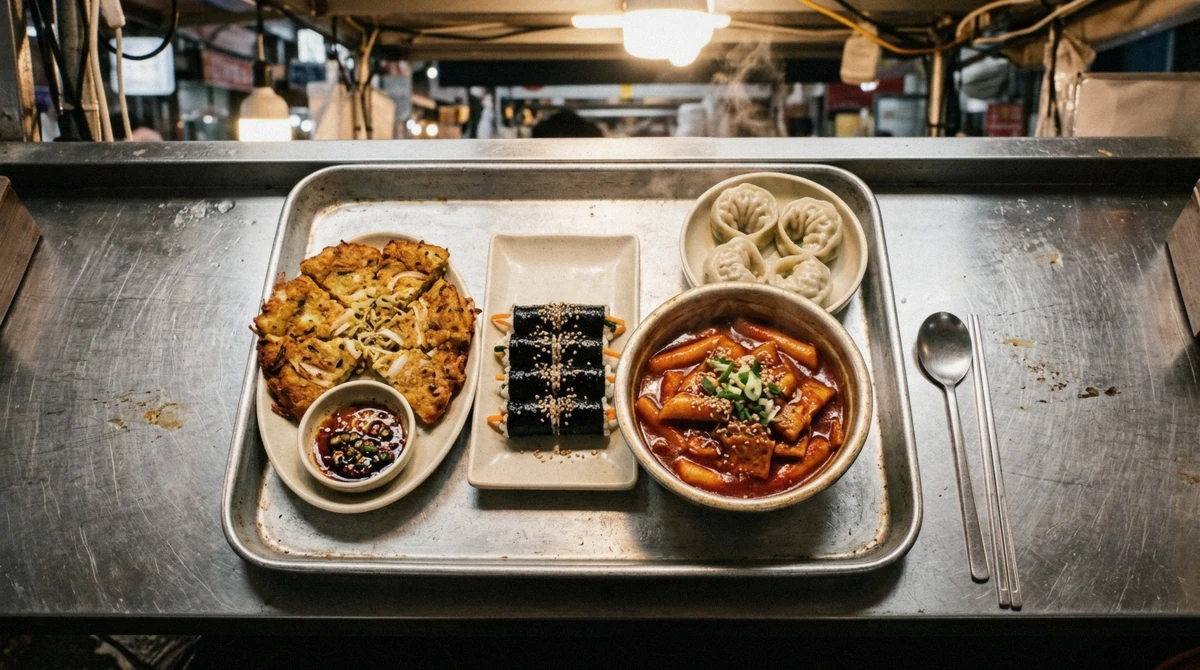
On nearly every Seoul food tour you'll eat bindaetteok, mayak gimbap and tteokbokki; most tours add kalguksu, mandu and a fish-cake skewer; the brave-points dishes, sundae and yukhoe, only appear if your group is up for them. A tour like the flagship 3-hour walk serves 8 or more tastings, and the 12-tasting route runs closer to a full meal circuit.
Key takeaways
- Bindaetteok, mayak gimbap and tteokbokki appear on almost every tour route in Seoul
- Kalguksu, mandu, odeng and jeon are common but not universal; expect them on most tours
- Sundae (blood sausage) and yukhoe (raw beef) are the brave-points dishes, offered rather than forced
- Kalguksu broth is usually anchovy-based even when it looks vegetable-clear, worth knowing if you're vegetarian
- The 8-tasting flagship and the 12-tasting route both send you home properly full
- See the table below for exact prices and which tours serve what
At a Glance: What's Actually on the Plate
Every row below uses one of three likelihood terms: nearly every tour, most tours, or some tours. Nothing here is a guarantee, since the exact stops shift by guide and by group.
| Dish | Where you'll taste it | Typical stall price | On which tours |
|---|---|---|---|
| Bindaetteok (mung-bean pancake) | Gwangjang Market | ₩5,000 (~$3.50) | Nearly every tour |
| Mayak gimbap (mini seaweed rice rolls) | Gwangjang Market | Small plate, a few thousand won | Nearly every tour |
| Tteokbokki (spicy rice cakes) | Most market stops | Cup or small plate, a few thousand won | Nearly every tour |
| Hotteok (brown-sugar pancake) | Namdaemun Market | ₩1,500 | Nearly every tour |
| Kalguksu (hand-cut noodle soup) | Gwangjang, Namdaemun | ₩8,000 combo at Namdaemun | Most tours |
| Bibimbap | Gwangjang Market | ₩6,000 regular, ₩7,000 hot-stone | Most tours |
| Mandu (dumplings) | Market stalls citywide | A few thousand won | Most tours |
| Odeng / eomuk (fish cake skewer) | Street stalls, Myeongdong | A couple thousand won per skewer | Most tours |
| Jeon (savoury pancake) | Market stalls | A few thousand won | Most tours |
| Fried chicken cups (Mangwon) | Mangwon Market | ₩5,000 | Some tours |
| Sundae (blood sausage) | Gwangjang, market stalls | Small plate | Some tours |
| Yukhoe (raw seasoned beef) | Gwangjang's Yukhoe Alley | ₩15,000 (yukhoe bibimbap) | Some tours |
| Sannakji (live octopus) | Select market stalls | Varies | Some tours |
Bindaetteok, yukhoe and mayak gimbap alone account for roughly 60% of food sales in Gwangjang's central corridor, which is a fair signal of what the market itself considers essential. The sections below go dish by dish through each tier; jump to Where Each One Lives further down for the exact stalls.
On Nearly Every Tour
These four are close to a sure thing; a tour that skipped all of them would be unusual.
Tteokbokki
Chewy rice cakes simmered in a red gochujang sauce, usually served bubbling in a shallow pan or ladled into a paper cup. Where: nearly every market stop and street stall on any route. When: available all day, every day.
Likelihood: nearly every tour. The genuinely memorable part is how much the sauce varies stall to stall, some sweeter, some sharply spicy, and regulars will walk past three vendors to reach the one they trust. It's a real medium heat, not a token spice.
If you're spice-shy, ask your guide for the milder version, covered in full in our Korean food etiquette guide.
Bindaetteok
Gwangjang Market's signature dish: a thick mung-bean pancake, ground fresh and griddled in oil until the edges turn crisp and golden. Where: Gwangjang Market, priced around ₩5,000 (~$3.50) as of early 2026. When: served all day at the market's food stalls, which run roughly 09:00 to 23:00 daily; the wider Gwangjang market itself is closed Sundays.
Likelihood: nearly every tour. The best stalls still grind their own mung beans on a stone wheel rather than buying pre-ground paste, and that difference is genuinely tasteable: a fresher, nuttier pancake than the pre-ground version most street carts serve elsewhere. Our 8+ tastings tour and the 12-tastings route both build a stop around this dish.
Mayak Gimbap
Literally 'narcotic gimbap': small, bite-sized seaweed rice rolls dipped in a mustard-soy sauce, named for how quickly people go back for more. Where: Gwangjang Market. When: all day, part of the market's big three alongside bindaetteok and yukhoe, together roughly 60% of the central corridor's food sales.
Likelihood: nearly every tour. The trick locals know is eating it in one bite rather than nibbling; the mustard hits differently that way. It's the dish most first-timers photograph before they even taste it, because the tiny rolls look almost too neat to eat.
Hotteok
A brown-sugar filled pancake, fried until the outside crisps and the filling turns molten. Where: Namdaemun Market, around ₩1,500 a piece. When: sold year-round but genuinely best in winter, when the cold makes the hot, syrupy filling feel like a small reward.
Likelihood: nearly every tour that passes through Namdaemun. The stall vendors flatten the dough with a metal press mid-fry, a satisfying hiss-and-sizzle moment that's part of the show as much as the eating.
On Most Tours
Common enough that you'll likely eat two or three of these, but not a certainty on every single route.
Kalguksu
Hand-cut wheat noodles in a savoury broth, one of Korea's most comforting market dishes. Where: Gwangjang and Namdaemun; the Namdaemun combo (kalguksu plus spicy cold noodles plus bibimbap) runs ₩8,000. When: available all day at both markets.
Likelihood: most tours. One honest note worth knowing before you order: the broth is typically anchovy-based even when it looks vegetable-clear, so it's not a safe pick if you're vegetarian; our Korean food etiquette guide covers the full vegetarian and halal picture for market food.
Mandu
Korean dumplings, steamed, pan-fried or boiled into soup, filled with pork, kimchi or vegetables depending on the stall. Where: market stalls across the city, often paired with kalguksu on the same plate. When: all day.
Likelihood: most tours. The pan-fried version with a crisped bottom is the one worth holding out for if your guide gives you a choice, since most stalls only crisp a batch on request rather than by default.
Bibimbap
Rice topped with seasoned vegetables, a fried egg and gochujang, mixed together at the table right before eating. Where: Gwangjang Market, ₩6,000 for the regular bowl or ₩7,000 for the hot-stone version, which keeps the rice at the bottom crisping while you eat. When: all day.
Likelihood: most tours. The hot-stone bowl is the one worth the extra ₩1,000 if it's offered; the scorched rice crust at the bottom is genuinely the best part, and stall regulars scrape for it deliberately.
Odeng / Eomuk
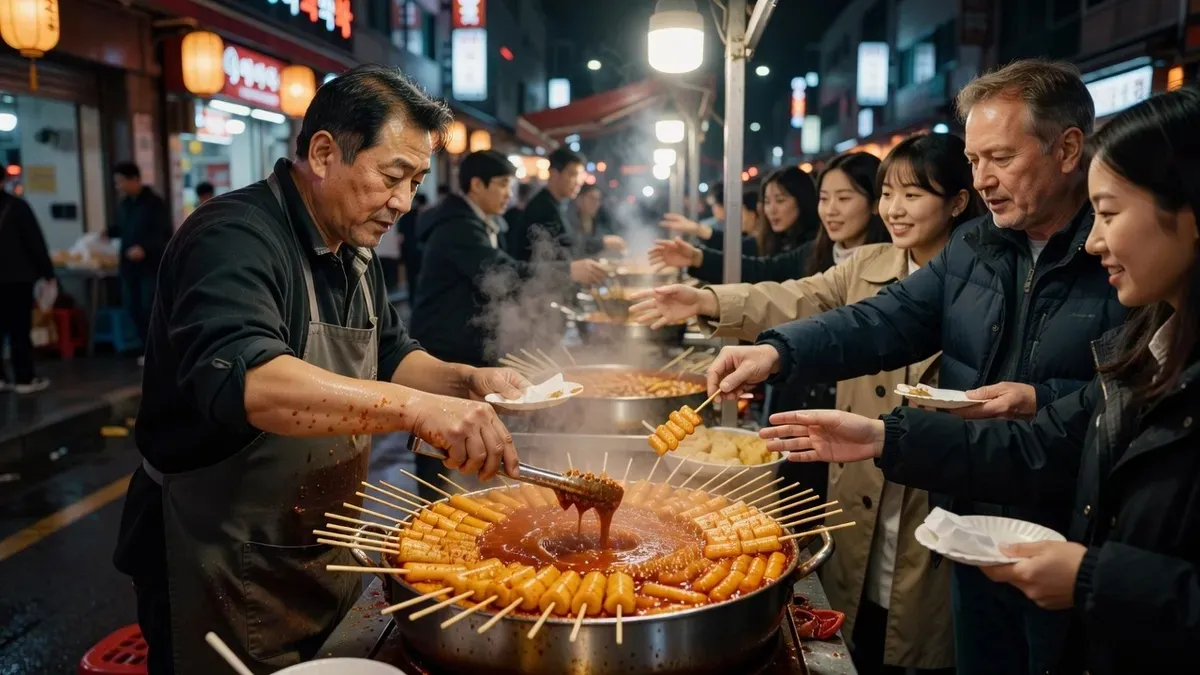
Fish-cake skewers simmered in a warm, savoury broth, sold at street carts and market corners across Seoul. Where: street stalls citywide, Myeongdong's night-food alleys in particular. When: year-round, though it feels most natural on a cold evening.
Likelihood: most tours. The broth itself is often free to sip in a paper cup while you eat the skewer, a small local courtesy most first-timers don't expect.
Jeon
A broader family of savoury pancakes beyond bindaetteok: scallion jeon, kimchi jeon and seafood jeon, pan-fried and often shared. Where: market stalls, particularly at Gwangjang and neighbourhood markets like Mangwon. When: all day.
Likelihood: most tours. Jeon is traditionally the dish of shared tables and rainy days in Korea, and a market stall version is a scaled-down taste of the same comfort-food role it plays at home.
The Brave-Points Dishes
Guides offer these rather than force them; nobody is pressured to eat something they're not up for.
Sundae
Korean blood sausage, plainly stated: pig intestine stuffed with glass noodles and pork blood, usually served with a side of lung and liver slices. Where: Gwangjang and market stalls generally. When: all day.
Likelihood: some tours, and always offered rather than assumed. The texture is closer to a savoury dumpling than most first-timers expect, and it's dipped in a salt-and-pepper mix or a spicy sauce rather than eaten plain. If it's not for you, saying so is completely normal and your guide will simply move on.
Yukhoe
Korean-style beef tartare: raw, seasoned hanwoo beef, sliced by hand at Gwangjang's dedicated Yukhoe Alley, where vendors cut fresh beef daily. Where: Gwangjang Market's Yukhoe Alley, where yukhoe bibimbap runs ₩15,000 at Buchon Yukhoe. When: all day, since the beef is cut fresh each morning rather than held over.
Likelihood: some tours. It's served with a raw egg yolk, sesame oil and pear, and the quality difference between Yukhoe Alley's dedicated butcher-vendors and a generic raw-beef dish elsewhere is real: this is the one place in Seoul built specifically around doing it right.
Sannakji
Live octopus, cut into small still-moving pieces and served with sesame oil. Where: select market stalls, not every route. When: available but not always on the tasting list.
Likelihood: some tours, and one honestly worth naming plainly before you agree to it. The movement is a nerve reaction rather than the octopus being aware, and it's chewy rather than dangerous, though it's genuinely the dish most first-timers need a moment to decide on.
Where Each One Lives: Markets and Named Stalls
The tiers above organize dishes by how often you'll eat them. This section flips the same picture around by place, since knowing the actual stall is what turns a food tour from generic to memorable, and it's the detail most guests ask me to repeat afterward so they can go back on their own.
- Gwangjang Market: the big three (bindaetteok, mayak gimbap, yukhoe) live here, plus kalguksu at Gohyang Kalguksu, the stall Netflix's Street Food: Asia made famous, run by Cho Yonsoon. It's still open, mid-market, opening at 09:00 and closed Mondays and the last Sunday of the month, so plan around that if you want to seek it out yourself. Yukhoe Alley is a short stretch inside the market entirely dedicated to raw beef vendors, worth a slow walk even if you're not ordering.
- Namdaemun Market: hotteok and the kalguksu combo cluster in what locals call Gourmand Alley, closed Sundays like the rest of the market's stalls.
- Mangwon Market: a neighbourhood spot young Seoulites actually eat at, known for fried chicken cups and tteokgalbi rather than the classic tourist-market dishes, a different flavor of the same street-food culture.
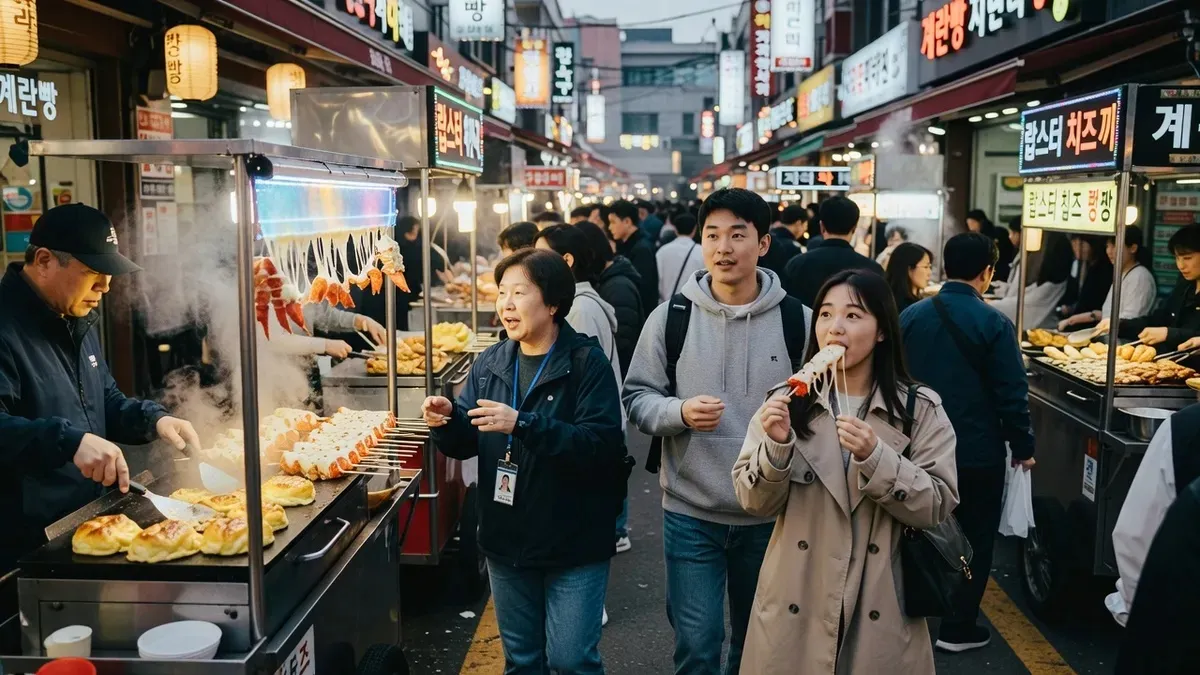
- Myeongdong: less a market than a night-food alley, best for odeng and other grab-and-go skewers between other stops.
For the full breakdown of market hours, subway exits and the posted-price rules that followed a 2025 overcharging incident at Gwangjang, our Seoul street food on your own guide carries that detail in full.
How Spicy Is All This?
Short version: hotteok and bindaetteok carry no heat at all, odeng broth is mild, and standard tteokbokki is a genuine medium spice rather than a token warning label. Our Korean food etiquette guide owns the full spice ladder, including the phrase to ask for a milder version.
Vegetarian and Halal Honesty
This deserves a plain answer rather than a vague reassurance, because Korean market food is genuinely hard for vegetarian and halal travellers. Kalguksu and most broths that look clear or vegetable-based are actually simmered on dried anchovies, and fish cake shows up hidden in dishes that read as vegetarian at a glance. Halal options at traditional markets like Gwangjang are close to nonexistent; there's essentially no certified halal stall in the market.
Bindaetteok is the safest ask of the group, since it's built from mung beans, but even then it's worth confirming the frying oil with the vendor directly. If dietary needs are a real concern rather than a mild preference, our private tour can build a route around your specific rules rather than working around a fixed group menu.
| Dish | Vegetarian? | Halal? |
|---|---|---|
| Bindaetteok | Usually, verify frying oil | Usually, verify frying oil |
| Kalguksu | No, anchovy broth | No, anchovy broth |
| Mayak gimbap | Verify, some kitchens share prep with meat | Verify with vendor |
| Bibimbap | No by default, has egg and often meat toppings | Verify meat toppings and oil |
| Odeng / eomuk | No, fish cake | Verify with vendor |
Our Korean food etiquette guide covers this in full, including how to phrase the ask at a stall.
What You Won't Usually Eat on a Tour
Two expectations trip up nearly every first-time guest, and both come from mixing Seoul's food scene up with something more familiar. The first is Korean barbecue as a sit-down, table-grill meal. That's a real and wonderful experience, but it belongs to a dinner reservation, not a walking market tour built around small tastings from multiple stalls.
If a sizzling tabletop grill is what you're picturing, book a KBBQ restaurant separately rather than expecting it mid-tour. The second is fine dining: tasting menus, chef's counters and hanjeongsik (the elaborate multi-course royal-style spread) are a different category of experience entirely, worth doing on their own evening rather than folded into a two- or three-hour market walk. What a market tour actually delivers is volume and variety, more dishes in one sitting than a single restaurant meal could reasonably serve.
Which Tour Feeds You What
Portion size and dish variety shift meaningfully by tour, so it's worth matching the route to your appetite before booking.
- 8+ tastings tour, $95, 3 hours: the flagship route, arrive genuinely hungry: this is a full meal spread across markets, backstreets and teahouses, plus a surprise dish your guide picks on the day.
- 12+ tastings tour, $88, 4 hours: the biggest volume on this site, working through Namdaemun and Gwangjang across a full lunchtime circuit rather than a snack-sized sample.
- Night palace and market tour, $79, 4 hours: an evening version with generous market tastings alongside an illuminated palace stop, good if you'd rather eat after dark.
All three sit in our lineup of Seoul market food tours, where the live price and today's availability show at checkout.
Frequently Asked Questions
Is sundae safe to eat on a food tour?
Yes. It's a normal, widely eaten Korean market dish, cooked and served fresh at busy stalls your guide already knows and trusts. The only real question is whether the flavor and texture, pig intestine stuffed with glass noodles and pork blood, are for you, not whether it's safe.
What if I'm vegetarian, can I still do a Seoul food tour?
You'll have real limits: kalguksu broth and several other dishes are anchovy-based, and fish cake hides in dishes that look meat-free. Bindaetteok is the safest bet, and a private tour can rebuild the route around your diet rather than the fixed group menu. Full detail in our Korean food etiquette guide.
How much food do you actually get on a tour?
The 3-hour flagship tour serves 8 or more tastings, and the 4-hour route runs 12 or more; both add up to a full meal, not a snack. Come hungry and skip the meal beforehand.
Will I have to eat the raw beef or blood sausage if I don't want to?
No. Yukhoe and sundae are offered, never forced, and guides read the group before pushing anything adventurous. Saying no thanks is completely normal.
Can I get Korean BBQ on a Seoul food tour?
Not usually. Sit-down tabletop-grill KBBQ is a separate restaurant experience, not part of a market walking tour. What you get instead is a wider variety of stall food across a shorter time.
Is Namdaemun or Gwangjang better for trying dishes?
Gwangjang has more dish variety in one place, including yukhoe and the Netflix-famous kalguksu stall; Namdaemun is calmer and better for hotteok and a straightforward noodle combo. Many tours combine both.
Do I get to choose what I eat, or is the menu fixed?
Group tours follow a set tasting route your guide has refined over time, though allergies and strong dislikes are always accommodated if you flag them early. The private tour lets you set the whole menu yourself.