Is a Food Tour in Seoul Worth It? An Honest Look

A food tour in Seoul is worth it if you want guided access to Gwangjang, Mangwon or Namdaemun without guessing which stall to trust and which dish is safe to order blind. Tours on this site run $41 to $138 per person, most between $65 and $95, and the flagship three-hour walk packs in eight or more tastings led by someone who already knows the vendors. It is not worth it if you already read Korean menus comfortably and have two spare days to eat your way through the same markets at your own pace, for a fraction of the price. So are food tours in Seoul worth it for you specifically? Below I break down what a tour actually buys, what it costs, and who should book the cheaper self-guided route instead. Compare all our guided food tours in Seoul once you've decided.
Quick answer
Yes, a food tour in Seoul is worth it for most first-time visitors: tours run $41 to $138 per person, the $95 flagship covers 3 hours with 8 or more tastings, and you leave having eaten dishes you'd likely skip on your own. Skip it only if you already read Korean menus confidently and have two free days to self-guide instead.
Key takeaways
- Tours run $41-$138 per person; the $95 flagship (3 hours, 8+ tastings) is rated 4.9 from 449 reviews
- The single best reason to book: you eat dishes like yukhoe and mayak gimbap that most solo visitors are too unsure to order blind
- Honest downside: vegetarians and halal eaters need to plan ahead, since most routes lean on pork, seafood or anchovy-based broths
- Skip it if you already read Korean menus and have two free days: self-guiding the same markets on your own runs close to a third of the price
- No best season to plan around: the markets and tours run year-round with no weather cancellation risk
The Short Answer
A food tour in Seoul earns its price by removing hesitation. Left alone at Gwangjang Market's 200-plus stalls, most visitors circle for twenty minutes, order the safe bibimbap, and walk past the bindaetteok pancake or the yukhoe raw-beef tartare that was actually worth crossing the city for. A three-hour tour compresses that hesitation into one guided loop with someone who already knows which stall is having a good week.
- Worth it if: you have one afternoon or evening free and want a guided introduction to Korean food rather than a self-taught one
- Worth it if: you don't read Korean and would rather someone else handle ordering, the small talk with vendors, and the "how spicy is this" question before it becomes a mistake
- Worth it if: you're traveling solo or as a pair and want the social ease of a small shared group instead of eating alone at a stall counter
- Skip it if: you already read Korean menus comfortably, or you're traveling with someone who does
- Skip it if: you're vegetarian, halal, or managing a serious allergy and the standard mixed-market route doesn't fit your needs without real advance planning
- Skip it if: your trip is short enough that a sit-down meal fits your schedule better than a two-to-four-hour moving tasting crawl
What a Seoul Food Tour Actually Costs
Prices below are per person, checked July 2026. Last verified: August 2026.
| Option | Typical price | Duration | Best for |
|---|---|---|---|
| Namdaemun Market Street Food Tour | $41 | 1.5 hours | A quick, budget-friendly first taste |
| Seoul Guided Food & Market Tour, 8+ tastings | $95 | 3 hours | The fullest introduction, most tastings |
| Seoul Street Food Market Tour | $73 | 2 hours | Solo travelers, most-reviewed option |
| Bukchon Traditional Community Food Walk | $138 | 3 hours | A slower, cultural deep dive in the hanok quarter |
Most travelers land in the $65-$95 band for a solid half-afternoon of tastings. The Namdaemun walk is the real budget floor at $41 for 90 minutes, and the Bukchon walk is the premium end at $138 for a three-hour version set among 600-year-old hanok lanes rather than a market alone. The gap between them is mostly duration and setting, not food quality.
Do the per-tasting math and the flagship tour looks more reasonable than the sticker price suggests: $95 for 8 or more tastings works out to roughly $12 per dish once you count the walking commentary and the guide's local knowledge as part of what you're paying for, not just the food itself. That framing matters more than the raw total when you're weighing it against a single restaurant meal.
What You Get for the Money
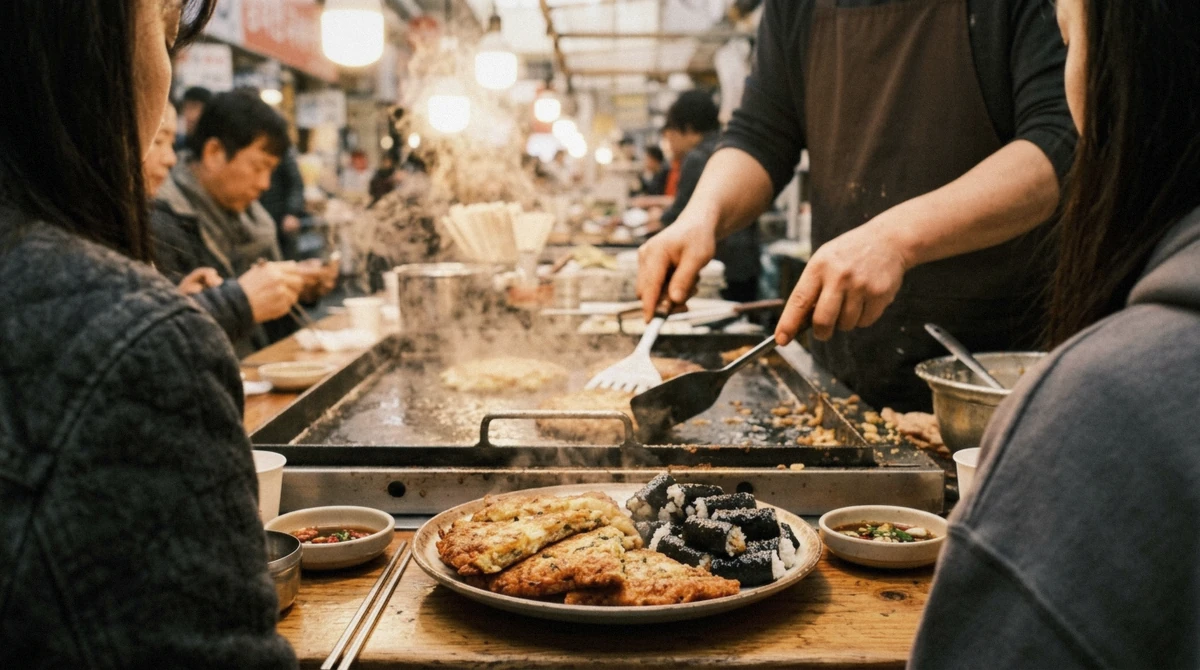
Book the flagship tour and this is roughly how the afternoon runs. We meet near Jongno 5-ga and start inside Gwangjang Market, Seoul's oldest, where the first stop is almost always a bindaetteok stall, the mung-bean pancake sold hot off the griddle for about ₩5,000 (roughly $3.50 at the July 2026 rate of ₩1,440 per US dollar). From there the route works through the market's food alley, ordering plates most solo visitors would walk straight past: mayak gimbap rolled bite-size, a spoon of yukhoe raw beef tartare from one of the stalls in Yukhoe Alley, tteokbokki if the group hasn't had enough spice yet.
Over three hours the flagship tour covers eight or more tastings, easily a full dinner's worth of food by the time you finish, so skip lunch beforehand if you can manage it. Most routes thread through a second market or a backstreet beyond Gwangjang, and many guides end with something unannounced, a "secret dish" that changes with the season and the relationships the guide has built with vendors over years of running the same loop.
What you're really paying for shows up in the small moments a solo visitor would miss: the guide steering the group away from a stall that's clearly slowed down that week, the aside about why a certain pancake batter uses mung bean rather than wheat flour, timing that gets you to the busiest corner of Gwangjang right as the lunch crowd thins rather than at its peak. None of that shows up on a menu, and it's the real difference between eating at a market and touring one. For the dish-by-dish version, tier by tier with named stalls, see what lands on your plate on a Seoul food tour.
- Included: the guide, every tasting on the route, and commentary on what you're eating and why
- Not included: extra rounds if you want seconds, and any drinks beyond water
The Honest Downsides
This is the part most tour pages skip.
- Sunday scheduling gets tighter. Namdaemun Market closes entirely on Sundays. Gwangjang's food stalls stay open roughly 09:00 to 23:00 daily, but its general shops close 10:00 to 19:00 and also shut on Sundays, so a Sunday-only visit narrows your route options
- Vegetarians and halal eaters need to plan ahead. Most routes lean on pork, seafood, or dried-anchovy broths, and halal options are genuinely scarce at the classic markets, so message the operator first or book the private tour if this affects you
- Trust took a hit in late 2025, when a Korean YouTuber's video showed a Gwangjang stall overcharging a tourist. Stalls have since started posting prices in response, and our DIY market guide covers the posted-price rule that followed in full
- You are paying a real premium for convenience. A $95 flagship tour genuinely costs more than eating the same dishes alone, and confident eaters who read Korean menus and have two free days can self-guide the markets on your own for close to a third of the price
Guided Tour vs Eating on Your Own
Here's the honest comparison, side by side.
| Guided tour | On your own | |
|---|---|---|
| Cost | $41-$138 per person | Roughly ₩15,000-20,000 (about $10-14) for the same Gwangjang route, per our cost breakdown |
| Ordering | The guide orders and explains each dish | You read stall signs and point, or lean on a translation app |
| Coverage | A route the guide has refined over years | Wherever you choose to walk, at your own pace |
| Time needed | 1.5 to 4 hours, fixed schedule | Open-ended, easy to combine with sightseeing |
| Best for | First-timers and non-Korean speakers | Confident eaters with two spare days |
The premium a tour charges buys one specific thing: certainty. You know what you're eating, you know it's a stall worth trusting, and you don't spend your first hour in Gwangjang deciding where to start.
Who Should Do It, and Who Should Skip It
If this is your first trip to Seoul and you don't read Korean menus
book the flagship 3-hour tour, where the ordering and pacing are handled for you
If you're vegetarian, halal, or managing a serious allergy
message the operator first or book the private tour, where the route can be built around anchovy-broth-free dishes
If you already read Korean menus and have two spare days
self-guide instead: our DIY market breakdown has the real cost math
If your day is packed and you only have 90 minutes to spare
the compact Namdaemun walk runs $41 and covers the essentials without the longer commitment
If you want an evening plan that doubles as sightseeing
the 4-hour Night Palace & Market Food Tour pairs illuminated palace grounds with the tastings
How to Book Without Overpaying
Book three to five days ahead during high season, the cherry-blossom weeks in spring and the foliage weeks in autumn fill first. In the shoulder months you can often book the same week. Free cancellation matters more here than on weather-dependent tours, since Seoul rarely cancels a walking tour, but travel plans shift constantly, so look for it before you pay.
Group size is worth checking too. A shared tour with eight to twelve people moves slower through a market than one with four or five, simply because everyone needs a turn at the counter. If pace matters to you as much as price, read the group-size line in the listing before comparing two similarly priced tours on cost alone.
Matched to what you're after: first-timers and non-Korean speakers do best with the 3-hour flagship tour; solo travelers and budget-conscious visitors get the strongest reviews-to-price ratio from the 2-hour street food walk; couples wanting an evening plan that combines sightseeing with dinner should look at the Night Palace & Market Food Tour.
However you book, compare it against the full Seoul food tour lineup before you commit. The right pick depends more on your schedule and dietary needs than on price alone.
Frequently Asked Questions
Is a Seoul food tour worth it for a first-time visitor?
Yes, for most first-timers it's the fastest way to eat well without guessing. A 3-hour guided route covers 8 or more tastings and skips the twenty minutes of hesitation that comes with 200-plus unmarked stalls at a market like Gwangjang.
What's the cheapest way to do a Seoul food tour?
The 90-minute Namdaemun walk at $41 is the least expensive guided option. For a genuinely cheaper day, self-guiding the markets costs closer to $10-17 in food; our cost breakdown has the full math.
Can I do a Seoul food tour if I'm vegetarian or halal?
It's honestly harder here than in many food cities. Most street stalls use pork, seafood or anchovy-based broths, and halal options are scarce at the classic markets. Message the operator ahead of time or book a private tour so the route can be adjusted.
Why do some Seoul food tours cost more than others?
Duration and tasting count are the biggest factors, followed by whether transport is included (only the night tour bundles it) and whether the tour is private or shared. Our full price breakdown covers what drives each tier.
Is it worth doing a food tour if I only have one day in Seoul?
Yes, if food is a priority. A 2-hour tour still fits comfortably into a single-day itinerary alongside a palace visit or a shopping stop, and it front-loads the trip's best meal without you having to research it yourself. Book the morning or early-afternoon slot so the rest of the day is still free for sightseeing.
Can I skip the tour and visit the markets myself?
Yes, and it works well for confident travelers. Gwangjang, Mangwon, Namdaemun and Tongin are all reachable by subway with clear hours and posted prices at most stalls. See our full DIY market guide for routes, prices and closing days.